
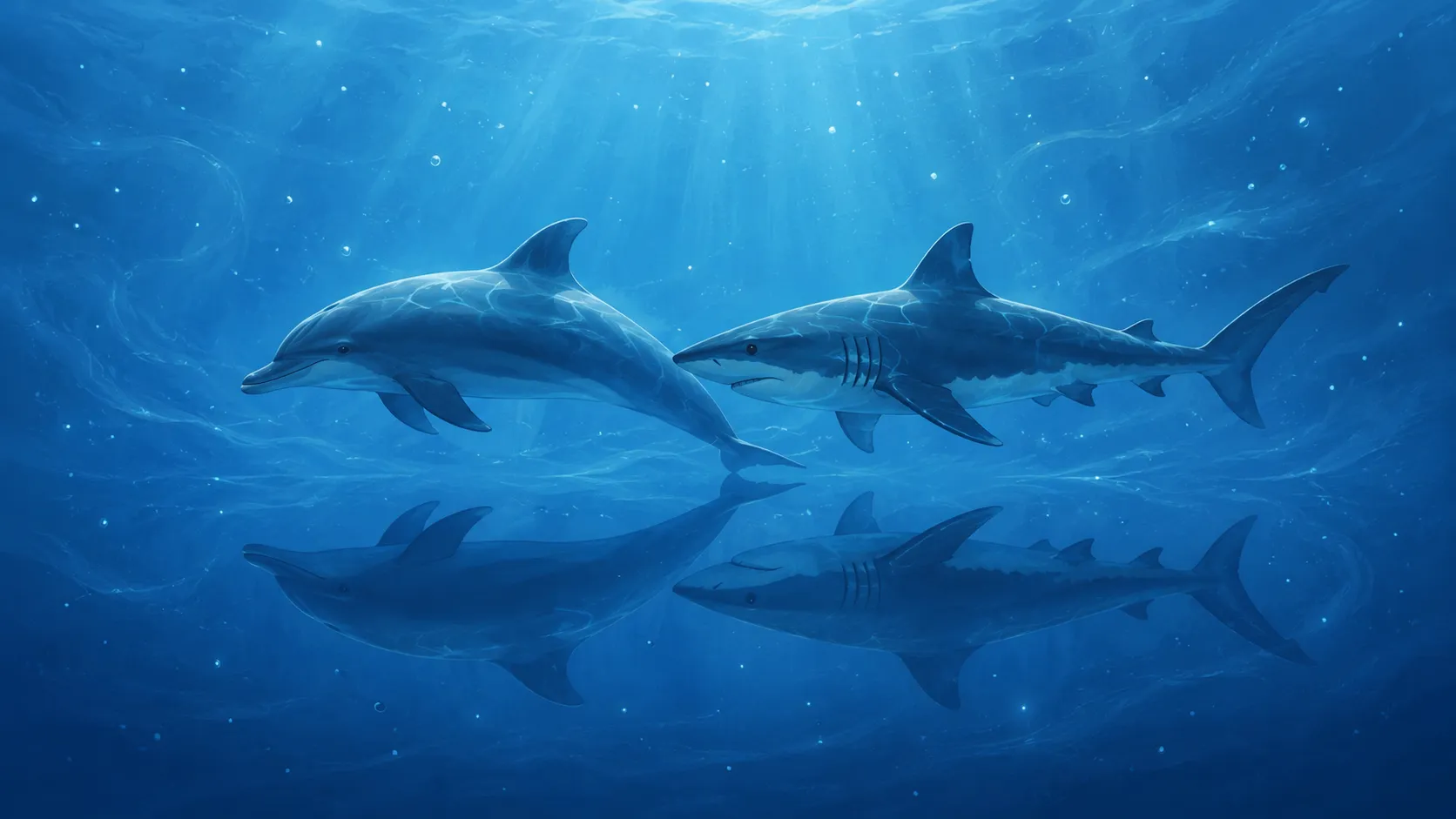
Imagine standing on a beach at sunset. Something slices through the surface of the ocean. A curved dorsal fin appears for a second, then vanishes into the water. Your brain instantly jumps to one conclusion: shark. But sometimes, that sleek shadow turns out to be a dolphin instead. At first glance, these animals seem almost like cousins of the sea. They both have streamlined bodies, powerful tails, fins on their backs, and the ability to move through water with astonishing speed. Yet the truth hiding beneath the surface is far more fascinating.
Dolphins are mammals descended from land animals, while sharks are ancient fish whose lineage existed long before dinosaurs walked the Earth. Despite being separated by hundreds of millions of years of evolution, both ended up with remarkably similar body designs. Scientists call this phenomenon convergent evolution, a process where unrelated species independently develop similar features because they face similar environmental pressures. Research published in Scientific Reports in 2023 highlighted how marine predators from entirely different evolutionary branches repeatedly evolved streamlined “thunniform” body plans optimized for fast swimming.
The ocean acts like a giant evolutionary testing ground. Water is dense, unforgiving, and full of resistance. Animals that waste energy fighting drag simply cannot compete for long. Over millions of years, nature repeatedly “selected” body shapes that moved efficiently through water. That is why sharks, dolphins, tuna, and even extinct marine reptiles like ichthyosaurs all evolved surprisingly similar appearances. It is almost like evolution keeps rediscovering the same engineering blueprint because it works so well.
What makes this even more intriguing is that the similarities are mostly skin deep. Underneath the sleek outlines are radically different skeletons, reproductive systems, breathing methods, and behaviors. Dolphins breathe air through blowholes and nurse their young with milk. Sharks breathe through gills and many species never care for their offspring after birth. One is warm-blooded and highly social, while the other is typically solitary and cold-blooded. Their matching shapes are less about family ties and more about survival mathematics in a demanding environment.
The Ocean’s Greatest Visual Illusion
Why People Often Confuse Dolphins and Sharks
Humans naturally rely on visual shortcuts. When two animals share a silhouette, our brains group them together. Dolphins and sharks both have torpedo-like bodies with dorsal fins rising above the waterline, making them easy to confuse from a distance. Hollywood movies and pop culture have also strengthened this association. Many people grow up seeing simplified ocean imagery where “fin equals shark,” even though dolphins display many of the same visible features.
The resemblance becomes even more striking when both animals are moving quickly. Their streamlined forms create smooth, fluid motion that looks almost identical from afar. This is not accidental. In open water, every bump, sharp edge, or awkward angle creates drag. Animals that swim efficiently conserve energy, travel farther, and catch prey more effectively. Over time, evolution trimmed away inefficient designs like a sculptor shaving stone into a smooth masterpiece.
Scientists studying marine locomotion often describe these shapes as fusiform, meaning tapered at both ends and wider in the middle. This design minimizes resistance while maximizing speed and stability. It is the aquatic equivalent of a Formula 1 race car or a bullet train. Research into shark and cetacean evolution shows that multiple marine predators independently evolved this same hydrodynamic body structure because the physics of water strongly favors it.
There is also a psychological factor at play. Humans tend to classify animals based on habitat rather than ancestry. Since dolphins and sharks both dominate marine ecosystems, people subconsciously assume they must be closely related. In reality, a dolphin is genetically closer to a cow or hippo than it is to a shark. That sounds absurd at first, but evolution often produces strange stories that challenge intuition.
The Survival Demands of Open Water
Life in the open ocean is brutally competitive. There are few places to hide, and predators must constantly move to survive. Fast swimmers have major advantages because they can chase prey, escape danger, and travel long distances efficiently. This pressure shapes body structures with ruthless consistency.
Think of the ocean like an endless marathon where every calorie matters. A poorly designed swimmer wastes precious energy pushing against dense water. Over millions of years, natural selection rewards creatures that reduce turbulence and maximize forward thrust. This explains why marine animals from completely different branches of life evolved similar body plans. Dolphins, sharks, tuna, and extinct ichthyosaurs all discovered nature’s “speed solution.”
A fascinating 2023 study found skeletal similarities among whales, sharks, and ancient marine reptiles despite their distant evolutionary relationships. Researchers concluded that environmental demands repeatedly pushed these groups toward the same efficient locomotion strategies. The ocean, in a sense, acts like a strict architect forcing unrelated species into similar designs.
A Shared Shape Built for Speed
The Science Behind Streamlined Bodies
The streamlined shape shared by dolphins and sharks is one of nature’s greatest engineering achievements. Their bodies narrow toward the head and tail while maintaining a thicker middle section. This form allows water to flow smoothly around them rather than crashing chaotically against sharp angles.
Hydrodynamics works a bit like aerodynamics in airplanes. The smoother the movement through fluid, the less energy gets wasted. Dolphins and sharks both evolved body structures that minimize drag while maximizing acceleration. Even tiny improvements matter. A slight reduction in resistance can save enormous energy during long-distance swimming.
Marine biologists often compare these body designs to advanced submarines because engineers intentionally mimic the same natural principles. Nature solved these problems millions of years before humans even imagined underwater vehicles. In fact, many modern underwater technologies borrow inspiration directly from dolphin and shark anatomy.
Research into marine convergence shows that the “thunniform” body shape evolved multiple times in ocean predators because it represents one of the most efficient forms for sustained high-speed swimming. Evolution is not random chaos; it often behaves like repeated experimentation under the same physical laws.
How Water Resistance Shapes Evolution
Water is roughly 800 times denser than air. That means moving through the ocean requires enormous force compared to moving through the atmosphere. Every wrinkle, protrusion, or inefficient movement becomes costly.
This explains why dolphins and sharks developed sleek skin, tapered bodies, and stabilizing fins. It is not simply about looking similar; it is about surviving in a medium that punishes inefficiency. Imagine trying to sprint through waist-deep mud all day long. That is the challenge marine animals face constantly.
Interestingly, even unrelated marine reptiles from prehistoric eras evolved nearly identical forms. Fossils of ichthyosaurs reveal creatures that looked uncannily dolphin-like despite being reptiles. This repeated pattern demonstrates the incredible power of convergent evolution. When organisms face the same environmental pressures, evolution often arrives at similar answers.
Scientists also discovered that body shape strongly correlates with ecological roles. Fast pursuit predators consistently evolve narrow, streamlined forms because speed becomes essential for hunting success. The ocean rewards efficiency with survival.
The Role of Fins in Ocean Movement
Dorsal Fins and Stability
The dorsal fin is perhaps the most iconic feature shared by sharks and dolphins. Rising from the back like a keel on a ship, it helps stabilize the body during movement. Without it, these animals would roll unpredictably while swimming at high speeds.
Even though both species possess dorsal fins, their structures differ internally. Shark fins are supported by cartilage, while dolphin fins contain connective tissue without bone support. Yet functionally, both serve similar purposes. This is another hallmark of convergent evolution: different materials producing similar outcomes.
The dorsal fin also improves maneuverability. In turbulent waters or during rapid turns, it acts like a stabilizer preventing unwanted rotation. Think of it as the ocean equivalent of an airplane wing fin. Evolution repeatedly favored this structure because stable movement increases hunting efficiency and reduces energy loss.
Tail Movement and Propulsion Differences
One of the clearest signs that dolphins and sharks evolved separately appears in their tail movement. Although both have powerful tails, they move in completely different ways.
Sharks Move Side-to-Side
Sharks swim using lateral motion. Their tails swing from side to side, generating propulsion through horizontal movement. This style reflects their fish ancestry. Most fish species rely on side-to-side undulation because their spines are built for that motion.
The shark’s skeleton, made primarily of cartilage, provides flexibility and lightweight efficiency. This allows smooth, wave-like movements that propel the animal forward with surprising power. Some species, like mako sharks, are among the fastest swimmers in the ocean because of this optimized body structure.
Dolphins Move Up-and-Down
Dolphins move their tails vertically, pushing up and down rather than side to side. This movement originates from their mammalian ancestry. Ancient land mammals flexed their spines vertically while running, and dolphins retained this pattern after returning to the sea.
This difference is more than a quirky detail; it is evolutionary evidence hidden in plain sight. Dolphins inherited spinal movement patterns from four-legged terrestrial ancestors. Sharks inherited theirs from ancient fish. Same environment, similar shape, completely different biological history.
Different Skeletons Beneath a Similar Appearance
Cartilage in Sharks
Sharks possess skeletons made mostly of cartilage instead of bone. Cartilage is lighter and more flexible, helping sharks move efficiently through water. This lightweight structure likely contributed to their evolutionary success for over 400 million years.
Cartilage also provides remarkable shock absorption. During sudden attacks or rapid turns, it allows sharks to maintain agility without the brittleness associated with dense bone. Their skeletons are simpler in some ways but perfectly suited for marine predation.
Sharks belong to a group called Chondrichthyes, meaning cartilaginous fish. Their evolutionary path diverged from mammals long before mammals even existed. That makes their similarity to dolphins even more extraordinary.
Bones in Dolphins
Dolphins, on the other hand, possess true bony skeletons like all mammals. Beneath their streamlined exterior lies evidence of their terrestrial ancestry. Their flippers contain bones structurally similar to human arms and hands, complete with finger-like arrangements hidden inside.
This is one of evolution’s most astonishing transformations. Ancient land mammals gradually adapted to aquatic life, reshaping legs into flippers and nostrils into blowholes. Studies of cetacean evolution reveal rapid anatomical changes linked to feeding strategies, echolocation, and swimming efficiency.
The contrast between shark cartilage and dolphin bone highlights an important truth: similar appearances do not always mean close relationships. Evolution can produce matching solutions using entirely different biological materials.
| Feature | Sharks | Dolphins |
|---|---|---|
| Classification | Fish | Mammal |
| Skeleton Type | Cartilage | Bone |
| Tail Movement | Side-to-side | Up-and-down |
| Breathing | Gills | Lungs |
| Reproduction | Eggs or live birth | Live birth |
| Body Temperature | Cold-blooded | Warm-blooded |
Hunting Styles That Shaped Their Bodies
Sharks as Ancient Predators
Sharks are among the oldest successful predators on Earth. Their hunting strategies evolved over hundreds of millions of years, refining bodies perfectly adapted for stealth, speed, and sudden bursts of power.
Many shark species rely heavily on smell and electroreception. They can detect tiny electrical signals emitted by prey hiding beneath sand or moving through dark water. Their streamlined bodies help them approach targets quietly before launching explosive attacks.
Different shark species evolved specialized hunting methods. Great whites use ambush tactics from below, while hammerheads sweep across the seafloor searching for buried prey. Despite these variations, the general shark body plan remains remarkably efficient.
Research into shark body forms found strong links between body shape, ecological role, and swimming performance. Evolution continuously fine-tuned these predators according to the demands of their hunting environments.
Dolphin Intelligence and Team Hunting
Dolphins took a very different evolutionary path. Instead of relying primarily on raw predatory instinct, they evolved advanced intelligence and social coordination. Their large brains support communication, problem-solving, and cooperative hunting strategies rarely seen in sharks.
Some dolphins work together to herd fish into tight groups before attacking. Others use echolocation to map surroundings with astonishing precision. Certain populations even develop unique hunting traditions passed down culturally from generation to generation.
This social behavior reshaped dolphin evolution. Intelligence became just as important as physical speed. Their bodies still needed hydrodynamic efficiency, but survival increasingly depended on communication and teamwork.
A fascinating aspect of dolphin evolution is how feeding strategies influenced skull development and sensory adaptations. Research on cetacean cranial evolution found strong connections between diet, echolocation, and skull morphology. Dolphins essentially became highly intelligent marine hunters wrapped inside streamlined bodies.
Skin Texture and Color Patterns Compared
Shark Skin and Drag Reduction
Shark skin feels surprisingly rough because it contains microscopic structures called dermal denticles. These tiny tooth-like scales reduce turbulence and improve swimming efficiency. Engineers have even copied shark skin textures when designing swimsuits and ship coatings.
The denticles channel water flow in ways that reduce drag and inhibit bacterial buildup. Nature transformed shark skin into a biological performance suit long before humans invented hydrodynamic materials.
Sharks also often display countershading: dark backs with lighter undersides. This coloration acts like camouflage. Seen from above, the dark back blends into deep water. Seen from below, the lighter belly matches sunlight filtering from the surface.
Dolphin Skin and Hydrodynamics
Dolphin skin is completely different in texture but serves similar hydrodynamic purposes. It feels smooth and rubbery, constantly renewing its outer layer to reduce drag. Recent studies into dolphin-inspired engineering explored how skin microvibrations may help minimize water resistance even further.
Like sharks, dolphins often display countershading. This shared coloration pattern emerged because both animals face similar visibility challenges in open water. Again, convergent evolution appears not only in body shape but also in surface design.
Scientists continue studying dolphin skin because it may inspire more efficient underwater vehicles and advanced materials. Nature repeatedly proves itself to be one of the world’s greatest engineers.
Where the Similarities End
Breathing and Reproduction
Despite their visual similarities, dolphins and sharks differ dramatically in basic biology. Sharks breathe through gills, extracting oxygen directly from water. Dolphins must surface regularly to breathe air through blowholes.
Their reproduction is equally different. Dolphins give live birth and nurse calves with milk, just like other mammals. Shark reproduction varies widely, with some laying eggs while others give live birth without mammalian-style parental care.
Dolphins are also warm-blooded, maintaining stable internal temperatures regardless of surrounding water conditions. Most sharks are cold-blooded, although a few species evolved partial warm-blooded adaptations for faster swimming.
These differences remind us that external similarity can hide profound biological divergence. Convergent evolution shapes appearances, but ancestry still leaves deep fingerprints beneath the surface.
Social Behavior and Communication
Dolphins are among the most social animals in the ocean. They communicate through whistles, clicks, and body language while forming long-term social bonds. Some even recognize individual “signature whistles” similar to names.
Sharks, in contrast, are generally far less social. Although certain species gather seasonally or show limited social preferences, they lack the complex communication systems seen in dolphins.
This divergence reflects different evolutionary priorities. Dolphins evolved intelligence-driven survival strategies, while sharks remained highly effective sensory predators. Same ocean, same physical challenges, completely different lifestyles.
What Convergent Evolution Reveals About Marine Life
Why Evolution Repeats Successful Designs
Convergent evolution demonstrates that nature often discovers the same solutions repeatedly. When unrelated species face identical environmental challenges, similar adaptations can emerge independently.
The streamlined marine predator body plan evolved multiple times across history. Sharks, dolphins, tuna, and extinct marine reptiles all converged toward similar forms because hydrodynamic efficiency consistently provided survival advantages.
This idea fascinates scientists because it suggests evolution is not entirely unpredictable. Certain environmental pressures strongly favor specific designs. In the ocean, speed and efficiency repeatedly produce torpedo-shaped swimmers.
You can think of convergent evolution like different inventors independently creating bicycles. The details may vary, but the final designs often resemble each other because physics limits what works best.
Lessons Scientists Learn from Dolphins and Sharks
Studying convergent evolution helps scientists understand not just biology but engineering, robotics, and medicine. Shark skin inspires antibacterial materials. Dolphin movement influences underwater robotics and naval design.
Researchers also use convergent evolution to explore broader evolutionary questions. If similar environments repeatedly produce similar solutions on Earth, could alien oceans create familiar-looking creatures elsewhere in the universe? It is a speculative idea, but one grounded in real biological patterns.
Marine evolution research continues uncovering how ecological pressures shape anatomy across unrelated species. Studies on aquatic mammals, sharks, and marine reptiles reveal that evolution often behaves less like random chaos and more like repeated experimentation under physical constraints.
The ocean tells a powerful story: survival shapes life in surprisingly predictable ways.
Conclusion
Dolphins and sharks may appear strikingly similar, but their resemblance is one of evolution’s greatest illusions. One descended from ancient fish, the other from land-dwelling mammals that returned to the sea millions of years later. Yet both evolved streamlined bodies, stabilizing fins, and efficient swimming adaptations because the ocean demanded those traits.
Their similarities reveal the immense power of convergent evolution. Nature repeatedly molds unrelated species into comparable forms when they face the same physical challenges. Water resistance, hunting pressure, and energy efficiency shaped dolphins and sharks into sleek marine athletes despite their radically different ancestries.
At the same time, their differences are just as important. Sharks breathe through gills, dolphins through lungs. Sharks swim side-to-side, dolphins up-and-down. Sharks rely heavily on sensory hunting, while dolphins combine speed with advanced intelligence and social coordination.
The next time you see a dorsal fin cutting through the waves, remember this: the ocean is not just home to creatures. It is a laboratory where evolution continuously experiments, refines, and occasionally arrives at the same brilliant solution twice.
FAQs
1. Are dolphins and sharks related?
No. Dolphins are mammals, while sharks are fish. Their similarities come from convergent evolution rather than close ancestry.
2. Why do dolphins and sharks both have streamlined bodies?
Streamlined bodies reduce drag in water, allowing faster and more energy-efficient swimming. Evolution favored this design in both species.
3. Do dolphins and sharks swim the same way?
No. Sharks move their tails side-to-side, while dolphins move their tails up-and-down because of their mammalian ancestry.
4. Which is smarter, dolphins or sharks?
Dolphins are generally considered far more intelligent due to their large brains, social behavior, and advanced communication systems.
5. What is convergent evolution?
Convergent evolution occurs when unrelated species independently evolve similar traits because they face similar environmental pressures.

Marlo Hale is a 35-year-old American writer living in Asheville, North Carolina. With a professional background in digital publishing and small business storytelling, he writes in-depth articles covering finance, entrepreneurship, and consumer education. His writing style blends factual research with approachable language, making complex topics easier to understand. Through his work for sharkanddolphin.xyz, Marlo consistently delivers reliable, well-structured content that supports reader trust and long-term credibility.