
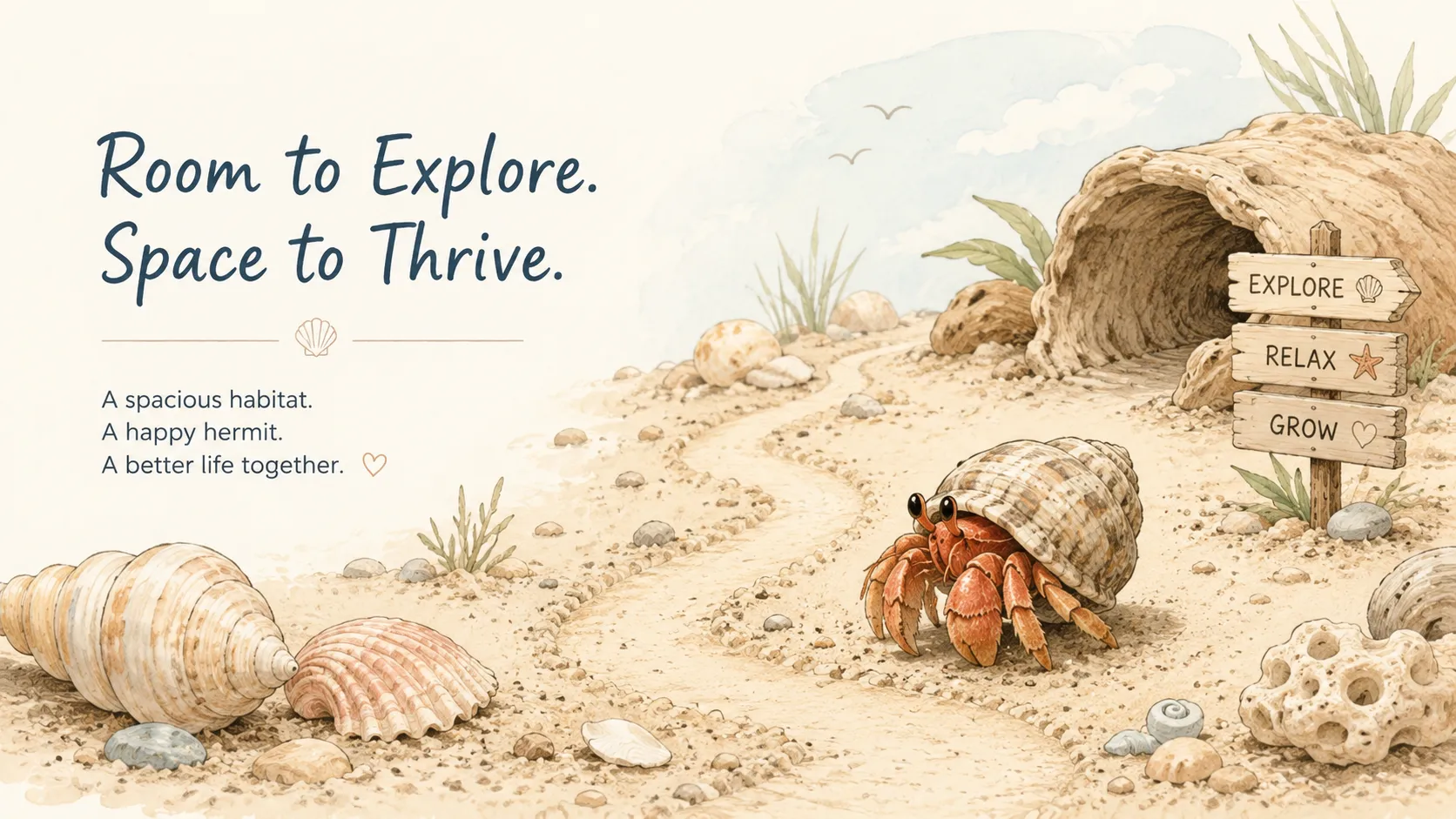
If you ask ten new hermit crab owners how much space a hermit crab needs, you’ll probably hear answers that range from a tiny plastic carrier to a small desktop tank. The problem is that hermit crabs have been marketed for years as low-maintenance pets that can comfortably live in cramped containers. The reality is very different. These fascinating crustaceans are active climbers, dedicated burrowers, social animals, and surprisingly complex creatures that require far more room than most beginners expect.
Modern hermit crab care recommendations have shifted dramatically as keepers and experts have learned more about their natural behavior. Many current care guides recommend at least 10 gallons of space per crab, while larger species may require even more. Experts also emphasize that floor space, substrate depth, humidity control, climbing structures, and shell availability are equally important components of the habitat.
Think about a hermit crab’s daily routine. It doesn’t simply sit in one spot waiting for food. It climbs branches, explores every corner of the enclosure, digs extensive tunnels, searches for better shells, interacts with tank mates, and occasionally disappears underground for weeks during molting. Trying to fit all those behaviors into a tiny enclosure is like asking a dog to spend its entire life in a closet. The animal may survive for a while, but it certainly won’t thrive.
Understanding how much space hermit crabs truly need is the foundation for building a healthy environment that supports their physical health, natural instincts, and long-term wellbeing.
Why Most People Underestimate Hermit Crab Space Requirements
One of the biggest reasons people underestimate hermit crab space needs is because pet stores often display them in extremely small containers. New owners naturally assume that if the store keeps them in those habitats, the setup must be acceptable. Unfortunately, many of these display habitats are designed for temporary housing rather than long-term care. Experienced hermit crab keepers frequently describe these small enclosures as one of the most common causes of poor health and chronic stress.
The misunderstanding becomes even more apparent when you consider how hermit crabs behave in the wild. These animals can travel considerable distances searching for food, water, shelter, and new shells. They spend their nights actively exploring and can cover surprising amounts of ground. In captivity, that instinct doesn’t disappear simply because they live behind glass. When space is limited, their natural behaviors become restricted, leading to boredom, stress, and reduced activity.
Another factor is their social nature. Despite the word “hermit” in their name, land hermit crabs are generally social animals. Many owners keep multiple crabs together because isolation can be stressful. Once multiple crabs share a habitat, the need for additional space increases dramatically. Each crab requires room to establish personal territory, climb independently, and molt safely underground without disturbance.
Many experienced keepers compare hermit crab care to creating a miniature tropical ecosystem rather than setting up a simple pet enclosure. When viewed from that perspective, it becomes obvious why a larger habitat is essential. The tank must support not only the crabs themselves but also deep substrate, water pools, climbing structures, feeding stations, shells, and stable environmental conditions.
The Myth of the Tiny Plastic Crab Habitat
The small plastic “crabitat” has become one of the most misleading products in the pet industry. These containers are often marketed as starter homes, yet they lack adequate room for digging, climbing, humidity retention, and temperature stability. Most cannot even accommodate the recommended six inches of substrate needed for safe molting.
A hermit crab living in a tiny enclosure faces constant limitations. It cannot establish normal movement patterns, create meaningful burrows, or avoid interactions with tank mates. Over time, these restrictions can contribute to chronic stress and behavioral issues.
Natural Behaviors That Demand More Room
Hermit crabs are remarkably active. They climb driftwood, investigate decorations, dig tunnels, and regularly search for alternative shells. These activities are not optional entertainment; they are deeply rooted survival behaviors. Restricting them can reduce overall wellbeing and make the animal less active and less healthy.
Tank Size Guidelines Based on Group Size
One of the most common questions new owners ask is exactly how large a hermit crab tank should be. While recommendations vary slightly among experts, most modern care resources agree that larger is always better. A frequently recommended guideline is approximately 10 gallons per crab, with a minimum of 20 gallons being preferable for a small group.
The following table provides practical sizing recommendations:
| Number of Crabs | Minimum Recommended Tank |
|---|---|
| 1 Small Crab | 10-20 gallons |
| 2 Small Crabs | 20 gallons |
| 3 Small Crabs | 30 gallons |
| 4-5 Small Crabs | 40-55 gallons |
| 6+ Crabs | 75 gallons or larger |
These recommendations aren’t based solely on movement. They account for substrate depth, environmental stability, shell storage, water pools, and future growth. Hermit crabs can live for many years and continue growing throughout their lives, meaning today’s small crab may eventually require significantly more space.
Larger tanks also make environmental management easier. Temperature gradients become more stable, humidity remains consistent for longer periods, and maintenance becomes less disruptive. Many experienced keepers who start with smaller tanks eventually upgrade because they discover how much easier care becomes in a larger enclosure.
Recommended Tank Sizes for One to Three Crabs
For beginners, a 20-gallon long aquarium is often considered one of the best starting points. It provides sufficient floor space for burrowing and allows owners to create distinct activity zones. Crabs can explore without constantly crossing paths, reducing competition and stress.
Housing Larger Hermit Crab Colonies
As colony size increases, the importance of space becomes even greater. Larger groups require additional shells, feeding areas, hiding spots, and molting zones. Without adequate room, aggression and shell competition become more likely.
Why Floor Space Matters More Than Tank Height
Many people focus on tank height because hermit crabs enjoy climbing. While vertical space is certainly valuable, floor space is even more critical. The primary reason is molting.
Molting is one of the most vulnerable periods in a hermit crab’s life. During this process, the crab buries itself underground and sheds its exoskeleton. It remains hidden while its new exoskeleton hardens. This process can take weeks or even months depending on the crab’s size.
To molt safely, hermit crabs require deep substrate and sufficient underground room. Experts commonly recommend at least six inches of substrate, though larger crabs may need considerably more. The substrate should maintain a sandcastle-like consistency to support stable tunnels and underground chambers.
A tall tank with minimal floor space may look impressive, but it often fails to provide enough room for multiple crabs to molt simultaneously. Wide tanks generally offer a better balance of usable space.
Burrowing Needs During Molting
When preparing to molt, a hermit crab instinctively searches for a safe location away from disturbances. If substrate depth is inadequate, the crab may be forced to molt on the surface, significantly increasing its risk of injury and stress.
Creating Safe Underground Space
The popular 5:1 mixture of play sand and coconut fiber remains one of the most widely recommended substrate choices because it holds tunnel structures effectively while retaining moisture. Proper substrate preparation supports both humidity levels and successful burrowing behavior.
Building Vertical Climbing Areas
Although floor space is essential, climbing opportunities are equally important for enrichment. Hermit crabs are natural explorers. In the wild, they navigate roots, rocks, driftwood, and other obstacles. A flat enclosure with no climbing structures can become monotonous very quickly.
Adding branches, cork bark, coconut hides, hammocks, ladders, and elevated platforms transforms a simple tank into a dynamic environment. These features encourage exercise and provide additional territory within the enclosure. Crabs frequently spend hours investigating elevated areas and moving between levels.
Climbing structures also help reduce social tension. When multiple crabs occupy the same habitat, vertical zones allow individuals to spread out and avoid constant interaction. This creates a more natural social environment where each crab can choose its preferred location.
Many owners notice increased nighttime activity after adding climbing features. Suddenly, crabs that appeared inactive begin exploring, climbing, and interacting with their environment in fascinating ways.
Branches, Platforms, and Hides
Natural-looking decorations do more than improve aesthetics. They create pathways, hiding places, and resting areas that mimic the complexity of tropical environments. Cork bark, driftwood, and coconut huts are particularly popular because they serve multiple purposes simultaneously.
Encouraging Exploration and Exercise
A well-designed habitat stimulates curiosity. Instead of moving between food and water bowls all day, crabs encounter obstacles, climbing challenges, and hidden spaces that encourage natural movement patterns.
The Connection Between Space, Humidity, and Temperature
Many new keepers focus exclusively on tank size without realizing that environmental conditions are closely connected to available space. Larger tanks are generally easier to maintain because they create a more stable microclimate.
Hermit crabs require warm temperatures and high humidity to breathe properly through their modified gills. Most care guides recommend temperatures between 75°F and 85°F and humidity levels between 70% and 85%.
In smaller tanks, environmental conditions can fluctuate rapidly. A slight temperature change in the room may significantly alter the enclosure’s climate. Humidity can drop quickly, creating stressful conditions for the crabs. Larger habitats buffer these fluctuations and provide a more stable environment.
The relationship between temperature, humidity, and behavior is also important. Crabs become more active when conditions are optimal. Stable environmental parameters encourage feeding, climbing, shell exploration, and social interaction.
Maintaining Stable Environmental Conditions
Digital thermometers and hygrometers are essential tools for monitoring environmental conditions. Many experienced keepers recommend avoiding analog gauges because they often provide inaccurate readings.
How Larger Tanks Improve Climate Control
Larger tanks allow for temperature gradients, giving crabs the ability to choose warmer or cooler locations. This freedom mirrors natural behavior and helps support healthy activity levels.
Shell Variety and Its Impact on Behavior
Imagine wearing the same pair of shoes for your entire life, even after outgrowing them. That’s essentially the situation a hermit crab faces when suitable shell options are unavailable.
Hermit crabs rely entirely on borrowed shells for protection. As they grow, they must continually upgrade to larger shells. They also evaluate shells based on weight, shape, internal space, and opening size. This shell selection process is a fundamental part of their behavior.
Experts often recommend providing multiple shell options for each crab. Some keepers maintain at least three to five suitable shells per crab to reduce competition and encourage healthy shell swapping behavior.
A lack of appropriate shells can lead to aggression, shell theft, and elevated stress levels. In crowded environments, these problems become even more pronounced because crabs have fewer opportunities to avoid one another.
Why Crabs Constantly Change Shells
Shell changing isn’t vanity. It’s survival. A better-fitting shell improves protection, mobility, moisture retention, and comfort. Crabs regularly inspect available shells and may switch multiple times before settling on a preferred option.
Choosing the Right Shell Selection
The best shell collection includes multiple sizes, shapes, and opening styles. Providing variety allows each crab to make its own choice rather than forcing it into a limited selection.
Common Mistakes That Cause Stress in Crowded Tanks
One of the biggest mistakes owners make is assuming that if crabs fit physically inside a tank, the enclosure is large enough. Physical fit is not the same as behavioral space. Hermit crabs need room to perform their natural activities without constant interference from tank mates.
Overcrowding often leads to increased competition for food, shells, climbing structures, and molting areas. Some crabs become less active while others display more aggressive behavior. These changes may develop gradually, making them easy to overlook.
Another common issue involves inadequate environmental control. Mesh lids, shallow substrate, poor humidity retention, and improper heating can create chronic stress even when the tank appears spacious. Many experienced keepers recommend sealed tops and side-mounted heating systems rather than heat lamps, which can dry the enclosure excessively.
Poor planning often compounds these problems. Owners may start with a small setup intending to upgrade later, only to discover that growth, shell accumulation, and additional equipment quickly overwhelm the available space.
Overcrowding and Aggression
Crowded conditions can increase shell disputes and territorial conflicts. While hermit crabs are social animals, they still need personal space.
Poor Environmental Management
Humidity loss, unstable temperatures, and inadequate substrate frequently occur in undersized tanks. These factors can have a direct impact on health and longevity.
Cleaning the Habitat Without Disturbing the Crabs
Cleaning a hermit crab enclosure requires a different mindset than cleaning many other pet habitats. Since crabs often spend extended periods underground, excessive disturbance can create unnecessary stress.
Routine maintenance should focus on spot cleaning. Remove leftover food, clean water dishes, and wipe accessible surfaces without disrupting substrate whenever possible. This approach minimizes stress while maintaining sanitation.
One of the most important considerations involves molting crabs. If a crab is buried underground, avoid digging through the substrate unless absolutely necessary. Disturbing a molting crab can interrupt a critical biological process and potentially lead to injury.
Many experienced keepers establish maintenance routines that prioritize environmental stability. Instead of frequent deep cleanings, they focus on preventive care through proper humidity management, substrate maintenance, and prompt removal of waste.
Routine Cleaning Strategies
Small daily tasks often eliminate the need for major interventions. Regular spot cleaning helps maintain a healthy environment without forcing crabs to repeatedly adapt to large-scale habitat changes.
Protecting Molting Crabs During Maintenance
Always assume a buried crab may be molting. Patience is often the safest approach. Allow the crab to emerge naturally before making major changes to the enclosure.
Creating an Environment That Encourages Natural Activity
The ultimate goal of hermit crab care isn’t simply keeping the animals alive. It’s creating an environment where they can display the same behaviors that make them so fascinating in the first place.
A successful habitat combines generous space, deep substrate, climbing opportunities, shell variety, stable humidity, proper temperatures, and social interaction. Each component supports the others. Remove one element, and the entire system becomes less effective.
Owners often report dramatic behavioral improvements after upgrading their tanks. Crabs become more active, more curious, and more willing to explore. They climb at night, dig elaborate tunnels, investigate new shells, and interact with their surroundings in ways that small enclosures rarely allow.
The transformation can be remarkable. A crab that once seemed inactive suddenly reveals a complex personality. It’s similar to watching a bird leave a cage and discover an aviary. The environment unlocks behaviors that were always present but previously restricted.
When evaluating a hermit crab habitat, ask a simple question: does the enclosure merely contain the crab, or does it encourage the crab to thrive? The answer often comes down to space.
Conclusion
Hermit crabs need significantly more space than many people realize. Modern care recommendations consistently emphasize larger tanks, deeper substrate, stable humidity, proper temperature control, and abundant enrichment opportunities. A habitat that supports climbing, burrowing, shell selection, and natural exploration allows hermit crabs to behave the way nature intended.
While minimum tank sizes provide a useful starting point, bigger almost always delivers better results. Larger enclosures improve environmental stability, reduce social stress, create safer molting conditions, and encourage healthy activity. By focusing on both horizontal and vertical space, owners can build thriving tropical habitats that support their crabs for many years.
A well-designed hermit crab enclosure isn’t just a tank. It’s an ecosystem built around the animal’s instincts, behaviors, and long-term health.
Frequently Asked Questions
1. Can a hermit crab live in a 5-gallon tank?
A 5-gallon tank is generally considered too small for long-term hermit crab care. Most modern recommendations suggest at least 10 gallons per crab, with larger habitats strongly preferred.
2. How deep should hermit crab substrate be?
Most experts recommend a minimum depth of six inches, although larger crabs may require even deeper substrate to support safe molting and burrowing behavior.
3. What humidity level do hermit crabs need?
Hermit crabs generally require humidity levels between 70% and 85% to support proper respiration and overall health.
4. Why do hermit crabs need extra shells?
Hermit crabs continuously grow and must move into larger shells over time. Providing multiple suitable shells helps reduce competition and supports natural shell-selection behavior.
5. Are hermit crabs happier in groups?
Yes. Despite their name, land hermit crabs are social animals and generally do better with compatible tank mates, provided the enclosure offers adequate space and resources.

Callen Rhodes is a 29-year-old American content writer based in Boise, Idaho. He specializes in outdoor recreation, technology, and lifestyle topics, combining years of blogging experience with careful research and practical insights. His work focuses on producing trustworthy, reader-friendly articles that prioritize accuracy and real-world value. As a regular contributor to sharkanddolphin.xyz, Callen is committed to creating informative content that reflects strong editorial standards and helps readers make informed decisions.