
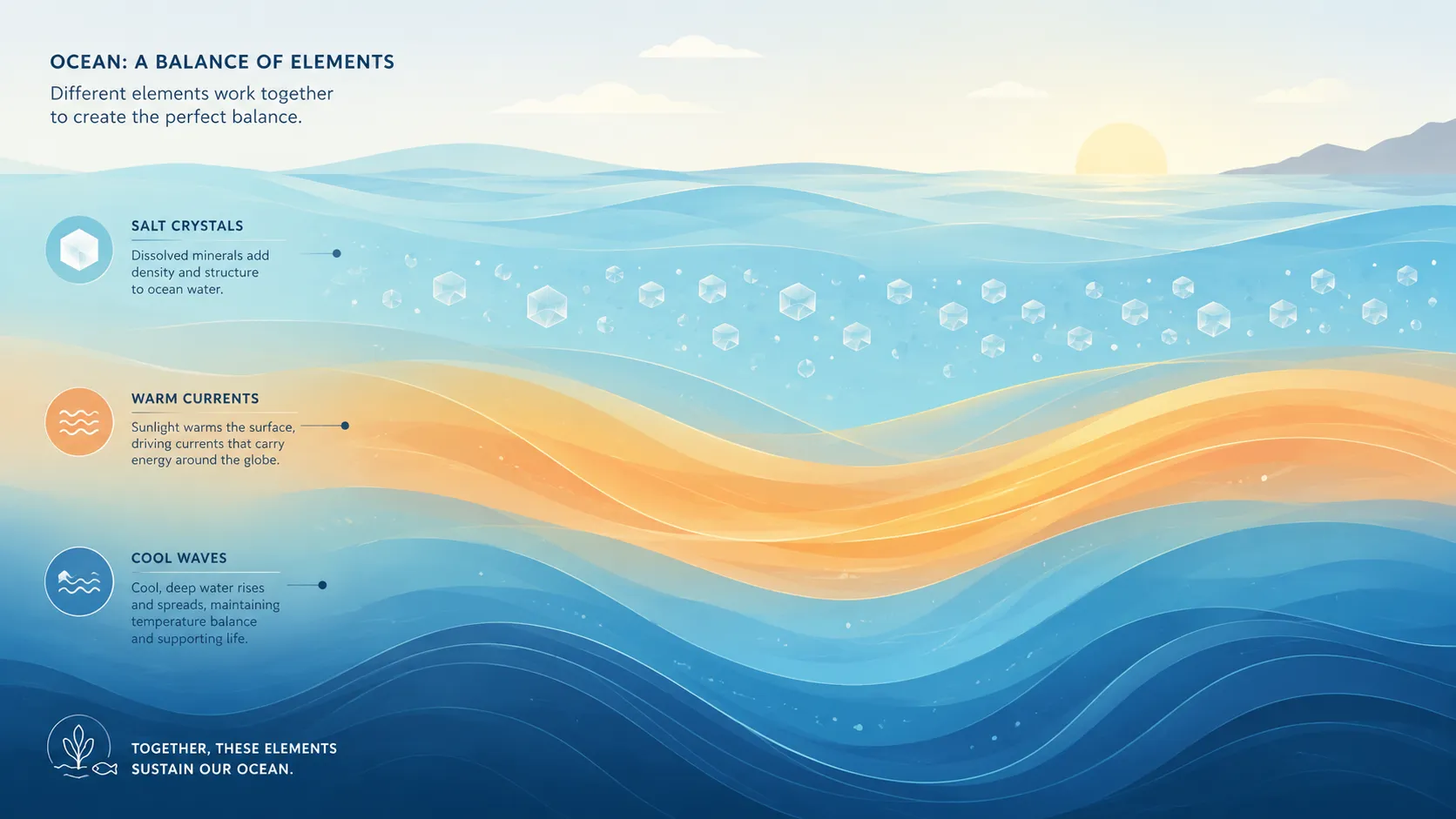
The world’s oceans may look like one massive body of water from space, but beneath the surface lies an incredibly complex system of layers, currents, and movements. At the heart of this system is ocean water density, a property that determines how seawater behaves, where it moves, and how it interacts with the atmosphere. Density may sound like a simple scientific measurement, yet it influences everything from global climate patterns to the migration routes of marine animals. Without density differences, many of the ocean currents that regulate Earth’s temperature would not exist.
Oceanographers often describe density as the “hidden architect” of the ocean because it quietly controls the vertical and horizontal movement of water masses. While winds can push surface waters across great distances, density differences are responsible for moving enormous volumes of water thousands of meters beneath the surface. These deep-water movements form part of the planet’s thermohaline circulation system, often called the global ocean conveyor belt. According to the National Oceanic and Atmospheric Administration (NOAA), deep ocean currents are largely driven by variations in temperature and salinity that alter seawater density.
Understanding what determines ocean density helps explain why some waters sink while others remain near the surface. It also reveals why the Arctic, Antarctic, tropics, and mid-latitude oceans all behave differently. From salinity and temperature to pressure and regional climate conditions, multiple factors combine to shape the structure of the ocean. The story of ocean density is really the story of how our oceans function as a living, moving system.
Why Ocean Water Density Matters
The Hidden Engine Behind Ocean Movement
Imagine the ocean as a giant three-dimensional puzzle where every piece is constantly shifting position. Density acts as the invisible force determining where each piece belongs. When water becomes denser than the surrounding water, it tends to sink. When it becomes less dense, it rises or stays near the surface. This constant rearrangement creates circulation patterns that connect distant parts of the globe.
The significance of this process cannot be overstated. Deep ocean circulation moves heat, nutrients, dissolved gases, and carbon throughout the world’s oceans. Scientists often compare it to a massive conveyor belt operating on a planetary scale. Unlike surface currents driven by winds, density-driven currents operate slowly but affect the entire ocean basin. Some sections of this circulation can take centuries to complete a full cycle. Research highlighted by NOAA indicates that deep-water circulation continually redistributes ocean water across thousands of kilometers, affecting both marine ecosystems and climate systems.
The concept becomes easier to visualize when thinking about oil floating on water. Differences in density naturally separate fluids into layers. The ocean works similarly, although the density differences are much smaller and influenced by subtle changes in temperature and salt content. These small variations are enough to move immense volumes of seawater around the globe.
How Density Influences Climate and Weather
Ocean density doesn’t just affect life underwater. It has profound consequences for weather and climate on land. Warm ocean currents transport heat from tropical regions toward higher latitudes, while colder currents return toward the equator. This exchange helps regulate global temperatures and reduces climate extremes in many regions.
For example, the Atlantic Meridional Overturning Circulation (AMOC) transports warm water northward and contributes to the relatively mild climate experienced in parts of Europe. Scientists continue monitoring this system because changes in density caused by melting ice or shifts in salinity could influence future climate patterns. Recent oceanographic observations show ongoing efforts to understand whether changes in ocean density structures may affect long-term circulation strength.
Density-driven circulation also influences rainfall patterns, storm formation, and carbon storage. Oceans absorb large amounts of heat and carbon dioxide from the atmosphere, and density differences help transport these materials into deeper waters. In many ways, ocean density acts like Earth’s climate thermostat, quietly helping regulate the environmental conditions that support life.
The Relationship Between Salinity and Water Density
What Salinity Means in Ocean Science
Salinity refers to the concentration of dissolved salts in seawater. Although sodium chloride is the most familiar salt, seawater contains many dissolved minerals, including magnesium, calcium, and potassium compounds. Oceanographers typically measure salinity in parts per thousand (ppt), with average seawater containing roughly 35 grams of dissolved salts per kilogram of water.
Salinity varies significantly across different regions of the ocean. Areas with high evaporation rates, such as subtropical regions, often become saltier because water evaporates while leaving dissolved salts behind. Conversely, regions receiving heavy rainfall, river discharge, or melting ice tend to have lower salinity levels. These differences create distinct density patterns that influence ocean circulation.
One of the most fascinating examples occurs near polar regions. As sea ice forms, much of the salt is excluded from the ice itself and remains in the surrounding seawater. This process increases the salinity and density of nearby water. NOAA explains that the resulting dense water often sinks, helping initiate deep-ocean circulation systems that connect entire ocean basins.
Salinity changes may appear small on paper, but their effects are enormous. A slight increase in dissolved salts can significantly alter seawater density, creating the conditions necessary for vertical water movement and large-scale circulation.
Why Saltier Water Is Heavier
Think about dissolving sugar into a cup of tea. The liquid becomes heavier because additional material is packed into the same volume. The same principle applies to seawater. When salts dissolve, they increase the mass of the water without proportionally increasing its volume. The result is higher density.
The relationship between salinity and density is one of the most fundamental principles in oceanography. As salinity increases, density generally increases as well. This is why highly saline waters often sink beneath fresher waters. Regions like the North Atlantic and areas surrounding Antarctica are particularly important because they generate dense water masses that descend into the deep ocean and help drive global circulation patterns.
| Salinity Level | Relative Density | Typical Ocean Environment |
|---|---|---|
| Low Salinity | Lower Density | River-influenced coastal zones |
| Moderate Salinity | Moderate Density | Open ocean regions |
| High Salinity | Higher Density | Evaporation-dominated seas and polar waters |
The balance between salinity and temperature creates a dynamic system where water masses constantly compete for position. Sometimes colder water sinks despite having lower salinity. Other times highly saline water becomes dense enough to descend even when relatively warm. Understanding these interactions is essential for understanding the broader structure of the ocean.
How Temperature Changes Ocean Water Structure
Molecular Movement and Water Expansion
Temperature is perhaps the most intuitive factor affecting ocean density. Most people have observed how heated air rises because it becomes less dense. Water behaves similarly. As seawater warms, its molecules move more vigorously and spread farther apart. This expansion reduces density, causing warmer water to remain closer to the surface.
Colder water behaves differently. Reduced molecular motion allows molecules to pack more closely together, increasing density. This denser water often sinks beneath warmer layers. Across the global ocean, temperature differences create vertical density gradients that influence circulation patterns and water layering.
The effect is especially noticeable in tropical oceans where intense sunlight warms surface waters throughout the year. These warm layers form a kind of floating blanket above colder, denser water below. In polar regions, lower temperatures create much denser surface waters capable of sinking into the deep ocean. This contrast between warm tropical waters and cold polar waters plays a major role in global circulation systems.
Temperature changes also influence the amount of oxygen seawater can hold. Colder waters generally retain more dissolved oxygen than warmer waters. As a result, density patterns affect not only circulation but also the availability of life-supporting resources throughout the marine environment.
The Formation of Ocean Layers
The ocean is not a uniformly mixed body of water. Instead, it contains distinct layers created by differences in density. Oceanographers call this arrangement stratification. Warm, less dense water typically occupies the upper layers, while colder, denser water settles deeper below.
Between these layers lies a transition zone known as the thermocline, where temperature changes rapidly with depth. Similar transitions can occur with salinity, producing what scientists call a halocline. Together, these gradients create complex density structures that resist mixing.
You can picture stratification like a layered dessert in a glass. Each layer remains separate because density differences prevent easy mixing. The ocean behaves similarly, although storms, currents, and seasonal changes can occasionally disrupt these layers. Discussions among oceanographers often emphasize how these density boundaries influence nutrient transport, biological productivity, and ocean circulation patterns.
These layers are critical because they determine how heat, oxygen, and nutrients move throughout the ocean. Strong stratification can isolate deep waters for long periods, while weaker stratification encourages mixing and exchange.
Pressure Effects Deep Beneath the Surface
Increasing Pressure with Depth
Pressure is another factor influencing ocean density, although its effects are less obvious than those of temperature and salinity. Every meter of water adds weight to the water beneath it. As depth increases, pressure rises dramatically. At several thousand meters below the surface, seawater experiences pressures hundreds of times greater than atmospheric pressure.
This immense force affects the physical properties of water. Although liquids are relatively incompressible compared to gases, seawater still undergoes slight compression under extreme pressure. These changes become significant when considering the enormous depths found in ocean trenches and abyssal plains.
Deep-ocean environments therefore possess unique density characteristics. Water masses that formed at the surface can become even denser as they descend and experience increasing pressure. This contributes to the layered structure observed throughout much of the world’s oceans.
Pressure also influences the behavior of dissolved gases, marine organisms, and underwater geological processes. In many respects, the deep ocean resembles a different world entirely, governed by conditions that humans rarely encounter directly.
Compression and Density Changes
Although temperature and salinity dominate density variations near the surface, pressure becomes increasingly important at depth. Compression slightly reduces the volume of seawater, increasing density even when salinity and temperature remain unchanged.
This process helps maintain stable deep-water layers that can persist for centuries. Once dense water sinks into the deep ocean, it often remains isolated from the surface for extended periods. According to studies of thermohaline circulation, deep waters can take hundreds of years to complete their journey through the global ocean system.
The influence of pressure demonstrates that ocean density is not controlled by a single variable. Instead, it results from the combined effects of salinity, temperature, and pressure interacting across different depths and geographic regions. This interplay creates the complex structure that characterizes Earth’s oceans.
Why Dense Water Sinks and Shapes Ocean Currents
Thermohaline Circulation Explained
The term thermohaline circulation combines two key concepts: temperature (“thermo”) and salinity (“haline”). Together, these factors determine seawater density and drive one of Earth’s most important circulation systems. When water becomes sufficiently cold and salty, it grows denser than surrounding water and begins to sink.
This sinking process initiates a chain reaction. Surface water moves in to replace the descending water, which eventually cools and sinks as well. Over time, these movements create deep currents that extend across entire ocean basins. NOAA describes thermohaline circulation as a global-scale system driven primarily by density differences.
Unlike surface currents that respond quickly to changing winds, thermohaline circulation operates slowly and steadily. Its influence extends from polar regions to the tropics and from shallow coastal waters to the deepest ocean trenches. Because it moves heat and nutrients worldwide, it plays a central role in maintaining Earth’s environmental balance.
Scientists often refer to this circulation as the ocean’s heartbeat. Although slow, it continuously redistributes resources essential for climate regulation and marine life.
The Global Ocean Conveyor Belt
One of the most widely used analogies in oceanography is the global conveyor belt. This metaphor describes the interconnected system of surface and deep currents driven by density differences. Warm surface waters travel toward polar regions, where cooling and salinity increases make them dense enough to sink. Deep currents then transport this water through the ocean interior before it eventually rises elsewhere.
Britannica notes that thermohaline circulation extends from the surface to the seafloor and transports enormous quantities of water, heat, and nutrients around the globe.
| Process | Density Effect | Result |
|---|---|---|
| Cooling | Density Increases | Water Sinks |
| Evaporation | Salinity Increases | Density Increases |
| Ice Formation | Salt Concentrates in Water | Sinking Accelerates |
| Freshwater Input | Density Decreases | Sinking Slows |
This conveyor belt influences climate patterns across continents. Even modest changes in density can alter circulation strength, making ocean density one of the most important variables in climate science.
Seasonal and Regional Differences Across the Oceans
Polar Oceans Versus Tropical Oceans
Not all oceans are created equal. Conditions near Antarctica differ dramatically from those found near the equator. Polar oceans experience extreme cooling, seasonal sea ice formation, and frequent production of dense water masses. Tropical oceans, by contrast, receive intense solar heating that keeps surface waters warm and relatively buoyant.
These regional contrasts create distinct density structures. In polar regions, surface water can become dense enough to sink into the deep ocean. In tropical regions, strong heating encourages stable stratification that limits vertical mixing. This difference helps explain why major deep-water formation zones are concentrated near the poles.
Regional salinity variations add another layer of complexity. Areas with strong evaporation often become saltier, while regions influenced by rainfall or river discharge become fresher. Together, temperature and salinity create unique density signatures that define different ocean regions.
These signatures act almost like fingerprints, allowing scientists to trace the movement of water masses across vast distances.
Seasonal Mixing and Stratification
Seasonal changes can dramatically alter ocean density patterns. During summer, surface waters warm and become less dense, strengthening stratification. In winter, cooling increases density and promotes vertical mixing.
This seasonal mixing is crucial for marine ecosystems. Nutrients stored in deeper waters can rise toward the surface during periods of weaker stratification, fueling plankton growth and supporting entire food webs. Many productive fisheries depend on these seasonal cycles.
The balance between stratification and mixing varies from one region to another. Coastal waters often experience stronger seasonal fluctuations than open-ocean environments. These changing density patterns influence everything from oxygen distribution to the timing of biological productivity.
Oceanographers closely monitor seasonal density variations because they reveal how physical and biological processes interact throughout the year.
How Density Influences Marine Ecosystems
Nutrient Transport and Marine Productivity
Marine ecosystems depend heavily on nutrient availability. Many nutrients accumulate in deep waters as organic matter sinks and decomposes. Without mechanisms to return these nutrients to the surface, marine productivity would decline dramatically.
Density-driven circulation provides this essential transport system. Upwelling and vertical mixing bring nutrient-rich water into sunlit surface layers where phytoplankton can grow. These microscopic organisms form the foundation of marine food webs.
The connection between density and productivity is remarkable. A change in temperature or salinity that alters density can influence nutrient transport and ultimately affect fish populations, marine mammals, and seabirds. NOAA notes that thermohaline circulation helps distribute nutrients throughout the global ocean.
In this way, density acts as both an architect and a supplier, shaping marine habitats while delivering the resources needed to sustain life.
Impacts on Marine Species Distribution
Different marine species thrive under specific temperature, salinity, and density conditions. As density patterns change, habitats can shift. Fish, plankton, and other organisms often follow these changing environmental boundaries.
Ocean layers also influence migration pathways and feeding behavior. Some species remain near the surface, while others occupy deeper density-defined layers. The structure of the water column therefore determines where organisms live, feed, and reproduce.
Climate-related changes in density patterns may alter ecosystem dynamics in coming decades. Reduced mixing could limit nutrient availability in some regions, while changing circulation patterns may redistribute marine species. Recent discussions among researchers highlight concerns that altered salinity patterns and increased stratification could affect ecosystem productivity in several ocean basins.
The health of marine ecosystems is therefore closely tied to the physical structure created by density differences.
Climate Change and Future Ocean Density Patterns
Climate change is introducing new uncertainties into the ocean density equation. Rising global temperatures are warming surface waters, while melting glaciers and ice sheets add freshwater to many ocean regions. Both processes tend to reduce seawater density near the surface.
Scientists are particularly interested in how these changes might affect thermohaline circulation systems such as the AMOC. Because freshwater is less dense than salty water, increasing freshwater input could weaken sinking processes that help drive global circulation. Current research suggests ongoing monitoring is essential to understand how density-driven currents may respond in the future.
Changes in density also influence ocean stratification. Stronger stratification can reduce mixing between surface and deep waters, potentially affecting oxygen levels, nutrient transport, and marine productivity. Some studies have already identified significant salinity changes in portions of the Southern Ocean and Indian Ocean, raising questions about future circulation behavior.
The future of ocean density patterns will play a major role in determining climate stability, marine ecosystem health, and the ocean’s ability to absorb heat and carbon. Understanding these processes is becoming increasingly important as environmental conditions continue to evolve.
Conclusion
Ocean water density is one of the most powerful yet often overlooked forces shaping our planet. Determined primarily by salinity, temperature, and pressure, density controls how seawater moves, where it sinks, and how it circulates around the globe. These movements create the thermohaline circulation system that transports heat, nutrients, oxygen, and carbon through the world’s oceans.
The relationship between salinity and density explains why salty water often sinks beneath fresher water, while temperature differences create layered structures that define much of the ocean’s architecture. Pressure further modifies density at great depths, helping maintain stable deep-water masses. Together, these factors drive ocean currents, regulate climate, and support marine ecosystems.
From polar ice formation to tropical warming, regional and seasonal variations continually reshape ocean density patterns. As climate change alters temperature and salinity distributions, understanding these processes becomes increasingly important. Ocean density may be invisible to the eye, but it remains one of the fundamental forces governing life on Earth.
FAQs
1. What is the main factor that determines ocean water density?
Ocean water density is mainly determined by temperature and salinity. Colder and saltier water is generally denser than warmer and fresher water. Pressure also contributes, especially in deep ocean environments.
2. Why does salty water have a higher density?
Salt increases the mass of water without significantly increasing its volume. This makes seawater heavier and denser than freshwater, causing highly saline water to sink beneath less saline water.
3. What is thermohaline circulation?
Thermohaline circulation is the global movement of ocean water driven by differences in temperature and salinity. It forms a large-scale circulation system that transports heat, nutrients, and dissolved gases throughout the world’s oceans.
4. How does ocean density affect marine life?
Density influences nutrient transport, oxygen distribution, habitat formation, and ocean circulation. These factors affect where marine organisms live, feed, migrate, and reproduce.
5. Can climate change alter ocean density?
Yes. Rising temperatures and increasing freshwater from melting ice reduce seawater density in some regions. These changes can influence ocean circulation, stratification, and ecosystem health over time.

Callen Rhodes is a 29-year-old American content writer based in Boise, Idaho. He specializes in outdoor recreation, technology, and lifestyle topics, combining years of blogging experience with careful research and practical insights. His work focuses on producing trustworthy, reader-friendly articles that prioritize accuracy and real-world value. As a regular contributor to sharkanddolphin.xyz, Callen is committed to creating informative content that reflects strong editorial standards and helps readers make informed decisions.