
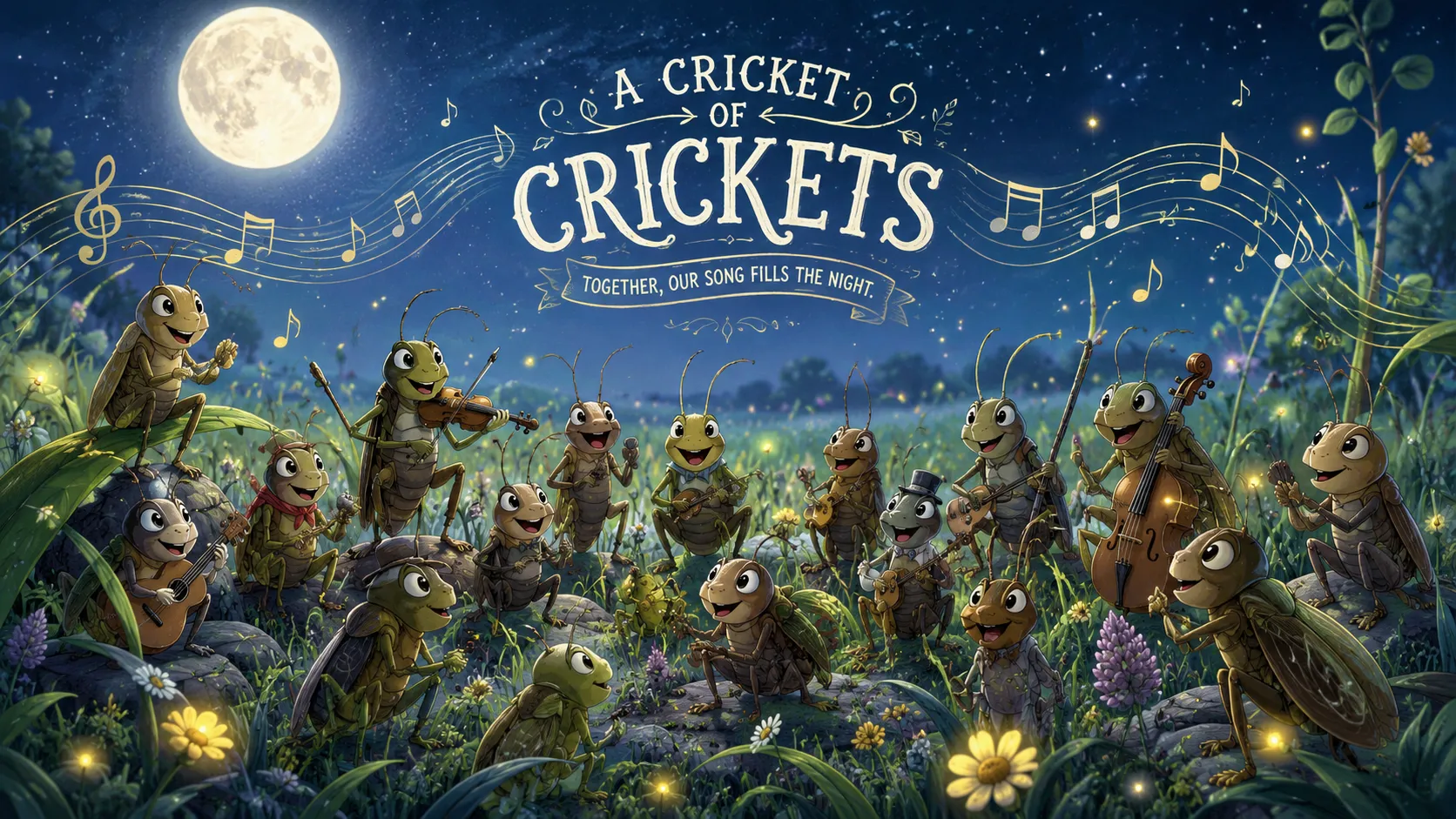
Language has a funny way of turning ordinary observations into memorable expressions. One of the most entertaining examples is the use of collective nouns for groups of animals. Instead of simply saying “a group of lions,” people often say a pride of lions. Rather than describing a gathering of crows as a flock, many English speakers know the famous phrase murder of crows. These names create vivid images in our minds and often reflect how humans perceive an animal’s appearance, behavior, or reputation.
Collective nouns have existed for centuries and became especially popular in medieval England. During that period, writers and hunters enjoyed inventing colorful names for groups of animals. Some of these names survived and became common in modern English, while others remained quirky curiosities found mainly in books and trivia lists. Linguists often refer to these unusual animal-group terms as part of a tradition known as “terms of venery,” which flourished during the 1400s.
Crickets belong to a category of animals that inspire particularly creative collective nouns. Unlike lions or wolves, crickets are not famous for strength or hunting skills. Their defining characteristic is sound. On warm evenings, the chorus of chirping insects creates an atmosphere that many people instantly associate with nature. Because sound plays such a central role in their identity, the collective term attached to crickets naturally reflects music rather than movement or appearance.
Understanding collective nouns helps us appreciate not only language but also the behaviors that inspired these descriptions. When people hear the collective name for crickets, they quickly realize that someone was paying close attention to the insect’s most remarkable trait: its ability to create a living symphony after sunset.
Why Humans Create Special Names for Animal Groups
Humans love patterns and storytelling. Giving special names to animal groups transforms simple observations into memorable expressions that are easier to share and remember. A colorful collective noun acts almost like a miniature story packed into a single word.
These names often reveal how people historically viewed animals. A parliament of owls suggests wisdom. A murder of crows hints at superstition and mystery. A pride of lions reflects power and dignity. The same pattern appears with crickets, whose reputation centers on sound rather than appearance.
The Historical Origins of Unusual Collective Terms
Many unusual collective nouns originated in medieval literature rather than science. Researchers note that numerous animal-group names were created as linguistic entertainment rather than strict biological terminology. Today, common terms like herd, flock, swarm, and school are used more frequently in scientific and everyday communication, while unusual collective nouns survive largely because people enjoy them.
That blend of creativity and observation is exactly why the cricket’s collective name remains so fascinating.
What Is a Group of Crickets Called?
The most widely recognized collective term for a group of crickets is an orchestra. This poetic name comes directly from the musical sounds produced by crickets when many individuals gather in the same area. Rather than focusing on their numbers, the term highlights the experience of hearing them together.
Imagine stepping outside on a summer evening. At first, you hear a single chirp. Then another joins in. Before long, dozens of crickets create a layered chorus that seems to come from every direction. The effect resembles musicians performing together, making “orchestra” a surprisingly fitting description.
Although orchestra is the most commonly cited collective noun, it is not the only phrase people use. Depending on the context, groups of crickets may also be described as a swarm, cluster, or simply a group of crickets. Scientists and entomologists generally prefer straightforward terminology, especially when discussing population density, migration, or ecological behavior.
What makes orchestra unique is its emphasis on sound. Most collective nouns describe physical movement, organization, or appearance. Cricket terminology stands apart because it celebrates communication and acoustics. The name captures the essence of what people notice first about crickets: not what they look like, but what they sound like.
The Meaning Behind “Orchestra” of Crickets
The word orchestra evokes images of musicians coordinating their efforts to create a unified performance. Crickets achieve something surprisingly similar. Each male cricket produces its own chirping rhythm, yet the combined effect becomes a rich and complex soundscape.
That connection between insects and music explains why the collective noun has remained popular despite not being an official zoological classification.
Other Terms Used for Cricket Gatherings
| Term | Typical Usage |
|---|---|
| Orchestra | Refers to the musical chorus of crickets |
| Swarm | Used when large numbers gather or move together |
| Cluster | Describes a concentrated group in one location |
| Group | General everyday term |
The context usually determines which expression people choose.
Why the Name “Orchestra” Fits Crickets Perfectly
Few insects are as closely associated with sound as crickets. Their nightly performances have inspired folklore, poetry, scientific research, and even weather observations for generations. The collective noun orchestra captures this connection beautifully because music is central to cricket behavior.
Crickets create sound through a process called stridulation. Male crickets rub specialized structures on their wings together to generate chirping noises. One wing contains a scraper, while the other contains a file-like row of ridges. As these parts move against each other, vibrations produce the familiar chirping sound.
Unlike random noise, cricket chirping serves specific purposes. Males attract females, establish territory, and communicate with rivals. Every chirp functions like a message being broadcast across the environment. When dozens or hundreds of crickets call simultaneously, the resulting chorus resembles a natural concert.
The orchestra metaphor becomes even more accurate when considering how different species contribute different sounds. Some produce rapid trills, while others create slower, rhythmic pulses. Together they generate layers of sound much like different instruments in a symphony. What seems like background noise is actually a highly organized communication network operating throughout the night.
The Science of Cricket Chirping
According to entomological research, chirp frequency varies significantly among species. Larger crickets often produce lower-frequency sounds, while smaller species create higher-pitched chirps. Some cricket songs can reach frequencies approaching 10,000 cycles per second.
This diversity adds complexity to the collective chorus.
How Multiple Crickets Create Natural Soundscapes
Large cricket populations transform quiet environments into vibrant acoustic landscapes. Forest edges, grasslands, and suburban gardens often become outdoor concert halls after dark. The effect can be surprisingly powerful despite the insects’ small size.
How Crickets Behave When Gathered Together
Many people assume crickets live in organized colonies like ants or bees, but their social structure is very different. Crickets are generally considered solitary or loosely social insects. They gather because of environmental opportunities rather than strict social organization.
Food availability is one major factor. Areas with abundant plant material, organic debris, or moisture can attract numerous individuals. Shelter also plays an important role. Crickets seek protection from predators and harsh weather, causing temporary concentrations to form around favorable habitats.
Even though they gather, cooperation remains limited. Individual crickets continue pursuing their own survival and reproductive goals. This creates an interesting balance between congregation and competition. The group provides certain advantages, but every insect is still focused on personal success.
Large gatherings often become especially noticeable during seasonal transitions. As temperatures change, crickets may concentrate around sheltered environments, creating dense populations that appear almost colony-like. These gatherings can attract attention because of both their numbers and their collective sound.
Resource Sharing and Survival
Crickets commonly congregate where resources are concentrated. Moist soil, fallen vegetation, and organic matter all attract populations seeking food and shelter. These gathering points can temporarily support large numbers of individuals.
Competition Within Cricket Groups
Despite living near one another, crickets compete intensely for mates and territory. Males frequently use sound to establish dominance and discourage rivals. The result is a community filled with both cooperation through proximity and competition through communication.
The Sounds and Signals That Dominate Cricket Groups
If crickets had a language, sound would be its foundation. Communication within cricket populations depends heavily on acoustic signaling. Nearly every important interaction involves some form of chirping or vibration.
The most familiar signal is the mating call. Male crickets broadcast these sounds to attract females from a distance. Each species has unique patterns that help females identify suitable mates. This reduces confusion in habitats where multiple cricket species coexist.
Territorial communication is equally important. Males use aggressive chirps to warn competitors and defend valuable spaces. Think of these sounds as verbal fences surrounding prime real estate. Rather than engaging in constant physical conflict, crickets often rely on acoustic displays to settle disputes.
Scientists continue studying how environmental factors influence these signals. Temperature, humidity, habitat structure, and population density can all affect chirping behavior. The result is a surprisingly sophisticated communication system hidden beneath what many people perceive as simple background noise.
Mating Calls
Mating calls are generally louder and designed for long-distance transmission. Their primary purpose is attracting females while advertising the male’s health and fitness.
Territorial Warnings
Aggressive chirps signal ownership and dominance. These calls help reduce direct physical confrontations between competing males.
Communication Through Stridulation
Stridulation remains the foundation of cricket communication. By rubbing specialized wing structures together, crickets generate a remarkable variety of signals that serve multiple biological functions.
Wild Cricket Groups vs Captive Cricket Colonies
Wild cricket populations and captive cricket colonies may contain the same insects, but their behaviors can differ significantly. Environment shapes nearly every aspect of cricket life, from movement patterns to communication habits.
In the wild, crickets must constantly respond to predators, weather changes, and resource availability. Their populations fluctuate naturally as conditions improve or deteriorate. Gathering locations may shift rapidly depending on food and moisture levels.
Captive colonies, by contrast, experience far more stable conditions. Food is predictable, shelter is constant, and environmental stressors are minimized. Because survival pressures are reduced, population densities can become much higher than those typically found in natural habitats.
The difference resembles comparing a bustling city to a wilderness landscape. Both contain living communities, but the rules governing behavior are very different. Captive environments often reveal behaviors that remain hidden in nature because resources are consistently available.
Environmental Differences
Wild crickets face fluctuating temperatures, predators, and competition for resources. These challenges shape movement patterns and group formation.
Behavioral Changes in Captivity
Captive populations often display altered feeding habits, higher densities, and reduced territorial spacing due to the consistent availability of resources.
Where Large Groups of Crickets Are Commonly Found
Crickets inhabit an impressive range of environments around the world. Members of the family Gryllidae occur across nearly every continent except the coldest polar regions.
Grasslands represent one of the most common habitats. These environments provide vegetation, moisture, and protective cover. Forest edges and meadows also support thriving populations because they combine shelter with abundant food sources.
Human environments can attract surprisingly large numbers of crickets as well. Artificial lights are particularly effective at drawing insects. Buildings, parking lots, and outdoor facilities sometimes experience temporary influxes when large cricket populations converge around illuminated areas.
Agricultural regions frequently host substantial cricket populations because crops and plant debris provide food. Urban gardens, compost piles, and landscaped areas can also become hotspots. Wherever warmth, moisture, and food combine, crickets tend to thrive.
Natural Habitats
Common natural locations include:
- Grasslands
- Meadows
- Forest edges
- Shrublands
- Moist soil environments
Urban and Human-Made Environments
Artificial lighting and landscaped vegetation often attract crickets into residential and commercial areas, especially during warm seasons.
The Ecological Importance of Cricket Populations
Crickets may seem small and insignificant, but their ecological impact is substantial. Every healthy ecosystem depends on countless organisms performing specialized roles, and crickets contribute in several important ways.
One of their primary functions involves decomposition. Many cricket species consume decaying plant material, helping break down organic matter. This process accelerates nutrient recycling and supports soil health. Without decomposers, ecosystems would struggle to process accumulated biological waste efficiently.
Crickets also serve as a critical food source. Birds, reptiles, amphibians, spiders, and mammals rely on them as prey. A decline in cricket populations could ripple through food webs, affecting many other species.
Researchers have also explored crickets as sustainable protein sources for humans. Their efficiency in converting food into body mass has generated interest in insect farming and alternative food production systems.
The next time you hear crickets chirping outside, it is worth remembering that those sounds represent more than background ambiance. They signal the presence of organisms actively supporting ecosystem health.
Crickets as Decomposers
By feeding on organic debris and plant matter, crickets contribute to nutrient cycling and soil productivity.
Crickets as a Food Source
Numerous predators depend on crickets. Their role in food chains makes them essential components of many terrestrial ecosystems.
Other Surprising Insect Group Names
Crickets are not the only insects blessed with unusual collective nouns. English contains a remarkable collection of names that range from poetic to downright bizarre.
| Insect | Collective Noun |
|---|---|
| Butterflies | Kaleidoscope |
| Bees | Grist or Swarm |
| Flies | Business |
| Caterpillars | Army |
| Gnats | Horde |
| Ladybugs | Loveliness |
These names reveal humanity’s tendency to connect language with observation and imagination. A kaleidoscope of butterflies captures visual beauty. An army of caterpillars reflects relentless movement. A business of flies suggests nonstop activity.
Many of these terms remain more popular in word games and trivia than in scientific writing. Still, they continue to fascinate people because they transform ordinary animal behavior into memorable expressions. The orchestra of crickets belongs proudly within this colorful tradition.
Famous Examples of Unusual Collective Nouns
Some famous examples include:
- Murder of crows
- Parliament of owls
- Pride of lions
- Kaleidoscope of butterflies
- Orchestra of crickets
Their popularity proves that language can be just as entertaining as biology.
Conclusion
A group of crickets is most commonly called an orchestra, a fitting term inspired by the insects’ remarkable ability to create layered musical choruses through collective chirping. While scientists may often use practical terms such as swarm or group, orchestra remains the most memorable description because it captures what makes crickets unique. Their gatherings are defined not by physical structure or hierarchy but by sound, communication, and environmental interaction.
Cricket groups form around food, shelter, moisture, and reproductive opportunities. Within these gatherings, males communicate through stridulation, producing calls that attract mates and establish territory. Whether living in grasslands, forests, gardens, or captive colonies, crickets play important ecological roles as decomposers and prey species.
The next time a summer evening fills with chirping, imagine an orchestra hidden among the grass. Each tiny musician contributes a note to a performance that has echoed through nature for millions of years.
FAQs
1. What is the official name for a group of crickets?
The most commonly recognized collective noun is an orchestra of crickets, although swarm and group are also frequently used.
2. Why are crickets called an orchestra?
The term refers to the combined chirping sounds produced by many crickets together, which resemble a musical performance.
3. Do crickets live in colonies like ants?
No. Crickets are generally solitary or loosely social insects and do not form highly organized colonies like ants or bees.
4. How do crickets make their chirping sounds?
Male crickets create sound through stridulation, rubbing specialized wing structures together to produce vibrations.
5. Why do large groups of crickets gather in one place?
Crickets gather where food, moisture, shelter, and mating opportunities are abundant. Artificial lights can also attract large numbers of individuals.

Drex Voss is a 27-year-old American blogger from Spokane, Washington. He has built experience writing about home improvement, personal technology, and practical everyday solutions while maintaining a strong focus on accuracy and transparency. Drawing from years of freelance writing and editorial collaboration, he creates engaging articles that balance expert research with clear explanations. As an author for sharkanddolphin.xyz, Drex values producing dependable content that readers can confidently rely on.